

We are still romantic
Mimi alla Ferrovia

Its tables have hosted famous actors, singers, football players, businesspeople but also those who appreciate good Italian food. Mimi alla Ferrovia is among the historical restaurants in Naples. A family venture that started 82 years ago, its reputation has now soared thanks to chef Sasa Giugliano. This may be because food here is prepared like a prayer, with lots of love, smiles and passion.
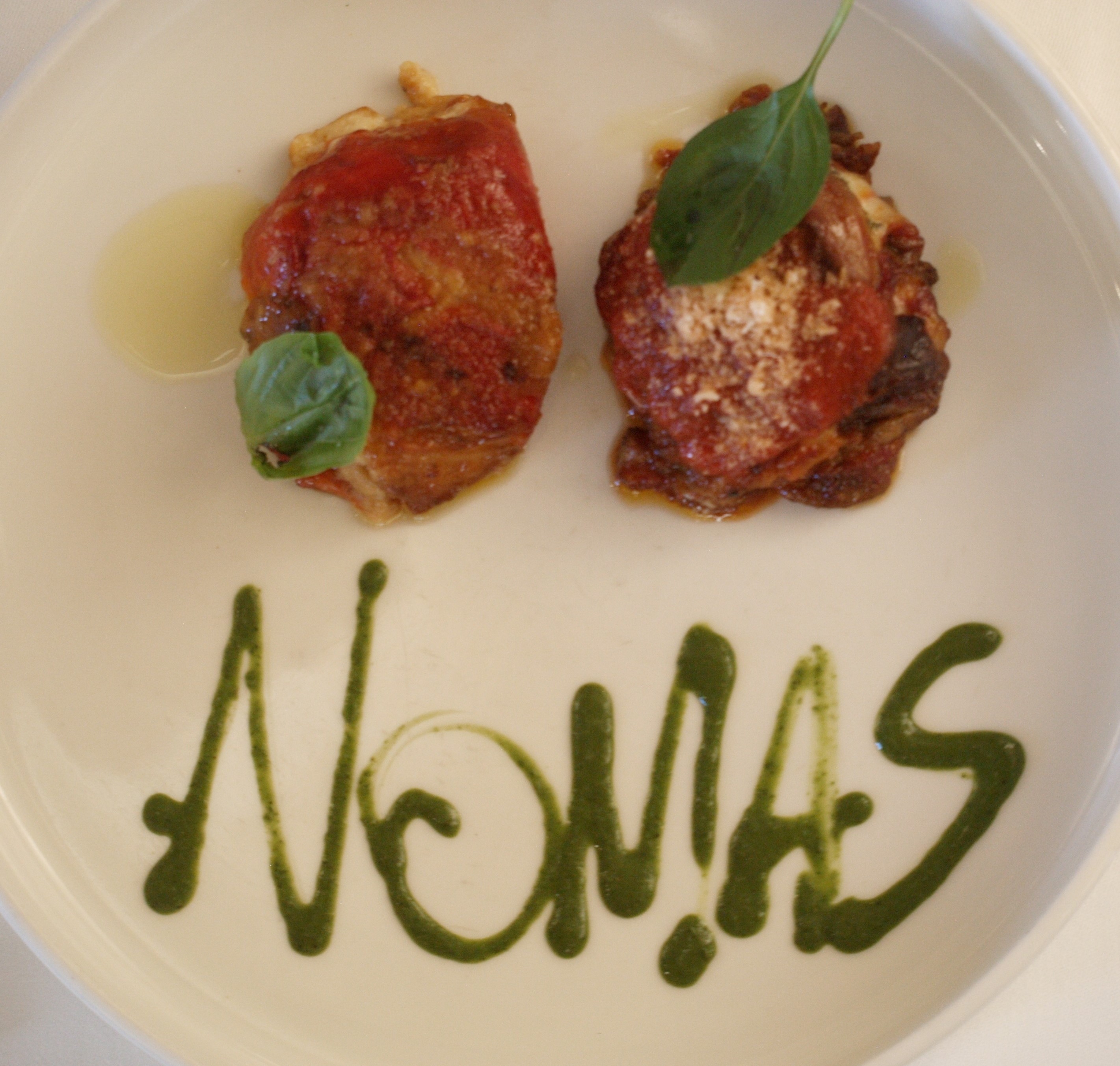
I take some photos of the open-plan kitchen and chef Sasa sets before me the tastiest bao Genovese I’ve ever tried. But what’s the connection between Asian bao buns and a traditional Italian eatery? Well, it’s the same as that between anchovies and wasabi. As I taste the eggplant in tomato sauce and the plain but delicious spaghetti lardiati, carefully cooked al dente and served with red sauce, cheese and basil, I feel as if I am turning to an Italian (tall and thin, given a choice), that my grandma lives in Sanitá and that I understand Italian like a mother tongue. Can food trigger fantasies? Here it can, apparently.
Chef Sasa takes off his apron and sits at my table while I try the sinfully tasting dessert that has landed before me. And what am I eating?, I ask. Baba au Rum, he replies, and I believe it’s the best one I’ve ever had – especially since until then I could swear I do not like baba at all: obviously, the ones I’d tried were all wrong. I ask who made it, and he reveals that the pastry chef is his wife, Carolina. They are expecting their first baby, a boy, in June. “I only live for this now”, he says and beams with joy.
How long has this restaurant been going, how long have you been a chef here?
You can see from the pictures on the wall that this is a family business. We did a photo exhibition two years ago here, for our 80 years of operation, and we wanted to show our history through 80 photos.
In this picture it is me and my cousin Ida, the girl who sits behind the cashier. And we have the same last name, Giuliano, because the founder, Mimì, was our uncle. Mimì was the nickname of Emilio. You can see there is one picture for every year. We start from 1943, when Mimi and his wife Ida started the restaurant. One year later my father Michele came from a town not far from Napoli to help uncle Mimi in this new adventure. He was 11 years old then. Today he is 92 and still working here -but not today, because he is sick. Mimi eventually left the restaurant to my father and to his own son, also called Michele, who is the manager of the restaurant. There was always the wife Ida behind the scenes to do some preparation in the kitchen. My father became the soul of the restaurant because he’s the host, the head waiter.
My uncle is the financial part of the restaurant, the administration. That’s why this combination of my father and my uncle is like the ying yang of the restaurant: from the early 70s, the 80s and then in the 90s they turned Mimi’s from a little trattoria to a world famous restaurant .
So we can say that you never stood a chance. Your future, your destiny were predetermined. (laughs)
I was born here, among these tables. You can see my pictures, also there, in the one with the lobsters. But my father never said to me what kind of job I had to do in my life; I grew up really free about my choices.
Who was the first one that you saw cooking? I mean, who was it that taught you how to cook?
I am the first one of the family to work in the kitchen; no one had worked in the kitchen before me. Before, there was a chef.
I started to work in the kitchen when I finished school. I was 18 years old and I worked here for six months. But I wanted to learn about the kitchen and so I asked my father and my uncle to send me to gain some experience outside Mimi’s. They said ‘yes’ very easily, and they were very happy about it. I worked in some restaurants here in Campania for four or five years. Then I worked in Japan in 2015.
Why did you choose Japan?
Because of the culture. I was always fascinated by the culture of Japan, not only for the kitchen but for the art, the education, the respect for everything; and I was born with this kind of magical Japanese vision. It was my last experience stage, and I asked for it to be in Japan. They said yes and I spent three months in Japan in three cities and worked in six different restaurants between Osaka, Kyoto and Tokyo.
Mimi is a very good traditional restaurant. It is open every day since 1943. But the menu was also traditional, without surprises. When I came back we started to do a kind of renovation, but not something really new or radical. My vision was to combine the traditional kitchen with the experience I had gained in Campania and Japan. To combine contemporary things with tradition. That’s why you see the anchovies with wasabi, the bao with Genovese; we also do the kimchi sauce with octopus and potatoes, which are typical in Napoli.
Your regular guests would expect to taste traditional food. How did they react to those changes?
I think they come here because we offer them a good experience. Good hospitality made of smiles, elegant irony in a good way, smart and friendly service in an ambience that you can see is very traditional, with lots of wood, white tablecloths… It’s a place where you don’t expect something to surprise you. The people who come for the first time can try some good pasta made with good techniques. That’s why, for example, we add the lard not at the beginning but at the end, so that you feel the flavour in the whole mouth.
If you are at Mimi’s, you know you can find a very good wine list of conventional wines but also a very good wine list with artisanal wines; and then you can find the typical Genovese pasta dishes that we’ve been doing for 70 years, but you can find also Genovese inside the Taco Bao with the anchovies. I think that the Neapolitan cuisine was always hybridisedby all the people who came into the city. We were dominated by the French, by the Spanish… tomato came to us from the US.This hybridisation is done by us, by the people who live in this city. If you can bring something new but never lose your identity, it can be more interesting and more surprising for those who come to Napoli for the first time.
Do you calculate when you cook?
It’s about heart, a lot of heart. Full of heart. (laughs). Only pastry requires a constant balance between the perfect sugar, salt, baking. For example, when you do a historical recipe, like the stuffed grilled pepper you tried earlier, we’ve been doing this for maybe 50 years. I remember the former chef Pellegrino Minucci, a very old chef, making the pepperoni in the same way that we do it now. But we didn’t learn by reading the recipe in a book, we learned it by watching the movement of his hands. That’s the best way to learn. We are still romantic.
Ιf you talk to someone who ate the peperroni 50 years ago and eats it again now, his memory will explode because it will take him back 50 years. The taste is the same. It’s incredible. We play a lot with the emotional side of our guests. Because one dish can remind them of, say, their grandmother who did the same pepperoni at home, or the same Genovese…
What is food for Italians?
It’s culture. It’s totally culture. In Southern Italy and mostly in Campania we are very lucky because we are in one of the best places in the world for biodiversity. We are in the heart of a region that gives us the best products in the world, perhaps. Because we are between the sea and the volcanic mountain, we have everything we need. As I said, food is culture. It’s a way to explain a story. Do you know the story of baba?
No…
Baba is a typical dessert from Napoli; the full name is baba au rum. If you come to Napoli, you can ask everyone what the most typical dessert is, and they will tell you it’s Baba, for sure.
Baba is not Italian and it is not French. It was born in Poland; French people took it from Poland when a pastry chef prepared it for Napoleon. Napoleon brought it to France, from France it came to Napoli and then Napoli adopted baba like its own dessert. Like the Genovese. Genova and Napoli are very important cities in Italy because of their ports. In the 19th century the chefs who worked on the ships of the port of Napoli and Genova exchanged recipes and ways of cooking. One of the chefs who prepared these onions and meat in Genova cooked the dish in Napoli, but Neapolitan pasta lovers added pasta to this sauce and that’s how we came to have candele alla genovese. A lot of stories also come from after the second world war, which was when the real Neapolitan kitchen was born. Because it was a time when people had little to eat, and used their imagination and creativity to cook. That’s how we have pasta with legume, with chickpeas, pasta with beans, with potatoes.
Pasta with potatoes?
It’s a very typical Napoli dish from the second world war. Poor people didn’t have much to eat but they needed energy, they needed carbohydrates. And what better way to take carbs if not from pasta and potatoes? And then over time they added the smoked mozzarella, they added the parmigiano, the guanciale and the basil. These are the real recipes of Neapolitan kitchen, by poor people who were ingenius in finding tasty ways to survive.
What is the typical Italian dessert and the typical Italian food?
The typical Italian dessert for me is only one, my favourite. If you asked me to choose one dessert and then die, it would always be tiramisu. It’s from northern Italy, from Treviso.
And from Napoli? Do you have something?
Of course, we have the pastiera. Pastiera is the typical cake that we do for Easter. Pastiera means the lunch of the day before, la pasta d’ ieri. You make the pasta frolla, you make the ricotta with sugar, grano, some orange and lemon zest. And you cook in the oven, then you leave it overnight to rest and you eat it the day after.
How stressful is your work?
Very stressful. We open for lunch and dinner every day, from Monday to Saturday. Sunday we are closed. And we work at the same pace every day.
How can you manage all this stress, day after day?
Only with passion. Passion for this job and for this restaurant. And out of respect for my family, for my father, for my cousin and for the guys who have been working here for many years. Luciano, for instance, has been here for 32 years, Roberto for 42; In the kitchen we have Michele working with us for 20 years, Roberto for 15 years, and Herminio for 40 years. And, of course, my cousin Daniela, a very strong woman: she’s my eyes and my hands when I’m not here. Without a good team you can do nothing. It’s important to share the same dreams with your team and to treat them well. We still dream every day that Mimi’s can be alive for another 100 years. Only by dreaming we can do big things.