

Two hours in the house of Ana Vidigal
 Interview and Photography: Lina Stefanou
Her home is her family house. An old high-ceilinged mansion in the Alfama district, from the late 17th century. You walk in and you cannot tell whether Ana is the house or it was the house that shaped Ana. A bohemian atmosphere in a formerly bourgeois setting with its roots deep in the past, as deep as the building’s foundations. This is the place where artist Ana Vidigal lives but also the place where she creates the collage paintings for which she is well known.
When she graduated from the Escola Superior de Belas-Artes de Lisboa, in 1984, she won a scholarship from the Calouste Gulbenkian Foundation. Since then, she had never stopped working and creating. In 2009 she represented Portugal in the Sharjha Biennial. In 2010 she did her first anthological exhibition at the Calouste Gulbenkian Foundation, under the title Menina Limpa, Menina Suja. Her latest major solo exhibition was Bela e Má, held in 2019 at the Museu Leopoldo de Almeida in Caldas da Rainha. Her works feature in many private collections, on the walls of several museums and Foundations as well as in two metro stations in Lisbon.
Half the house is neat and tidy. Then you walk into the studio and you come before the chaos of a creative mind. Books everywhere, a huge painting resting on the floor, countertops filled with objects. Ana collects all kinds of things. Photos of family and friends, photos of unknown people who left Portugal before the revolution; 1940s’ comics from her father’s collection; Mickey Mouse magazines from the 1950s; postcards… She shows me dozens of drawers filled with papers, cards, letters which she uses to make collages or foundations for her canvases, which are then painted over. The shelves of the large bookcases are overflowing with books in which she seeks inspiration or the titles of her works.
As she confesses to me, she often hoards things she does not like. For instance, the ribbons worn by university students in a traditional religious ceremony, with different colours for each university. She bought them on impulse at a fair, without knowing exactly why, and they are now kept in a huge drawer alongside other papers and objects she has collected the same way—without knowing why. Out of instinct; because they ‘spoke’ to her. She knows the time will come when their purpose will become clear—and then she will fit them into her work to make a new universe for memory to roam and meet this non-defined thing which awaits its time to appear.
“I think I have collected enough collage material for my whole life”, she says and smiles. “In the things I’ve kept from the family, there is History. But what I buy at fairs is things of people I never knew. So it is their form that makes me choose them. And the age they represent. For instance, I like things from the ’50s. I must have bought the student ribbons because I liked the colours; at the same time I am against this manifestation, a remnant of the old university system. So maybe I’ll use them in a project where I want to criticise something.
What do you criticize these days?
My condition as a woman. I am only talking about me; about the fact that I am a woman of 65, born before the Revolution in a conservative and privileged setting—a setting I had always recognised as such. The 25th of April was the most wonderful thing that happened to me. Because it gave me my freedom. There is this saying in Portuguese, “destino marcado”, which means marked destiny. And my destiny, within my social class and the environment I was born into, was written. But the revolution changed everything. Maybe I could have lived the life I live today, but with family problems. After April 25th, I could live the life I live today without family problems. Because the situation has changed. Everybody changed. And I didn’t have problems precisely because of the revolution. I remember going to Greece with my parents a little while after our revolution—and my father and mother were very conservative, as I said. In Greece, to my great joy, everybody was saying: “Ah, you’re Portuguese! Mario Soares!”. I saw my father’s face filled with wonder and annoyance. “But why is everybody talking about Soares?” I didn’t say anything, but I thought, “Well, Dad, because he’s a democrat.”
What do you remember from the day of the revolution?
I was 13 years old. I remember everything. Our phone rang at six in the morning. It was a cousin of my mother’s, a schoolmistress. The military had said that children should not go to school because there was a revolution, and she was calling to tell our mother we should not leave the house. So at six in the morning we all knew about the revolution at home. Most people went out in the streets, but we stayed in and did not know what was happening. My father was an architect, my grandfather a doctor. They were not opposed to the previous regime, and now they wondered ‘what will happen, how will our lives be?’. For me, life had become simply amazing because suddenly there was something called ‘freedom’! And all the people were happy. Of course, things became hard for us. There was no work for architects, and we went through some difficult years. Truly difficult. But we were free!”.
A sweet daylight comes through the high windows into the two large, adjoining rooms which have been turned into a studio. Ana points at two huge paintings, one propped against the wall and one lying on the floor.
“These are finished”, she says. “I am just waiting for them to dry fully so that I can apply the varnish”. Suddenly, she remembers something and walks towards the door. “Come, I want to show you the room I love the most”. I follow her and find myself in the kitchen!
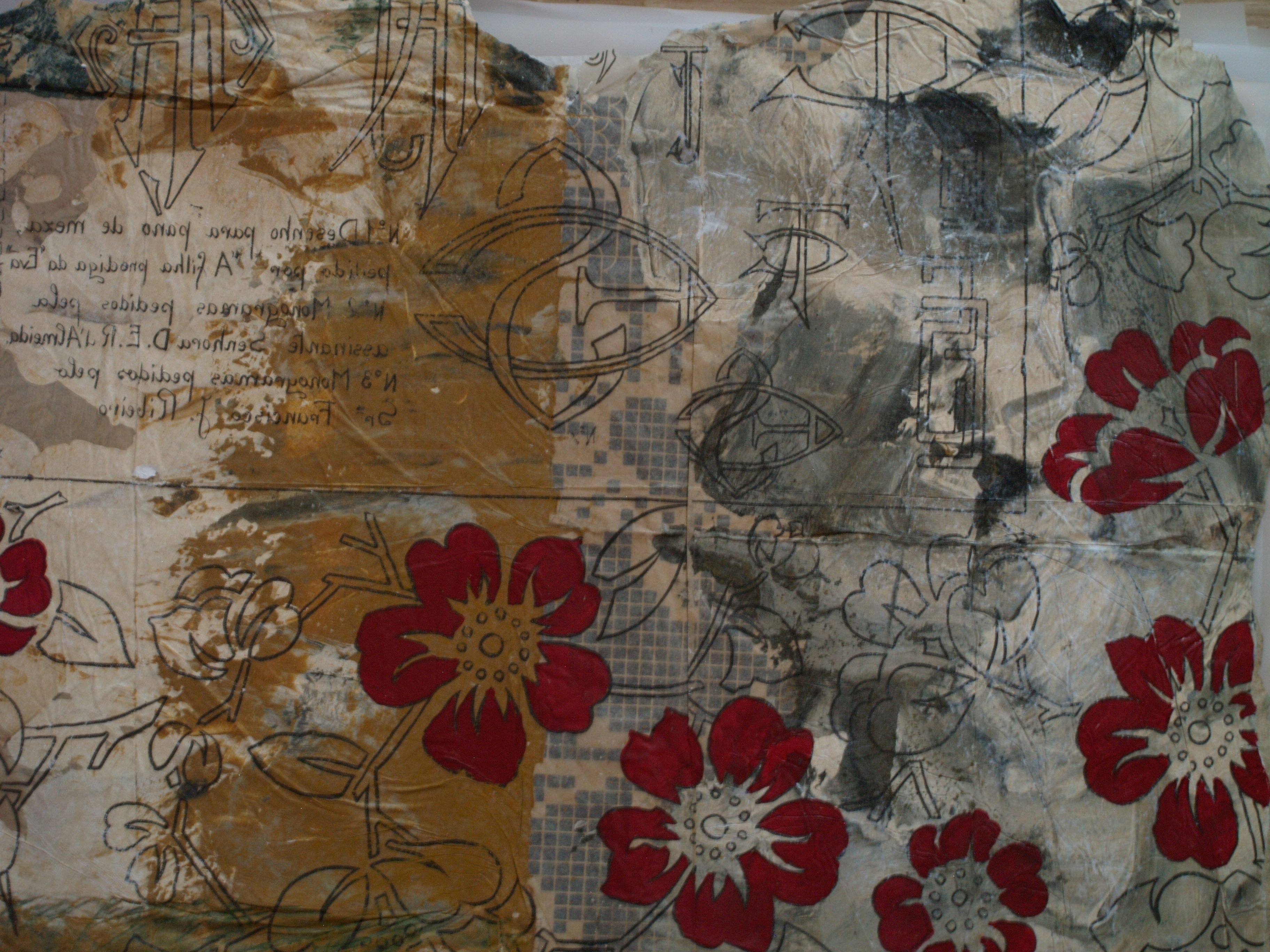
Her niece, Teresa, is there, working on her computer. I can see why. The blue waters of Tagus can be seen sparkling under the sunlight through the French doors; but what takes your breath away is the beauty of the azulejos in the river colours that line the walls. She lets me take some photos, and we go back to the studio. Ana opens a large folder and shows me the collages she has made for Egoista magazine. “I had a call from Patricia [the Editor] about a special tribute to writer Camilo Castelo Branco, on the bicentenary of his birth. She asked me to make 44 drawings for this issue. I was wondering what to make, as it was a long time since I had read Camilo’s books in my school days. And then I thought, I’ll do it like I do collages. In layers. Painting another thing on top of the main part. So I did it like this. I asked for some old books at the market, so that the paper I’d use would be aged. This way, I linked romanticism with the present time. Indeed, in one of the works I used one of my father’s old handkerchiefs. I built it like a book: you turn the pages, and there is a different work on each side—22 sheets, 44 drawings”.
The works are mixed-media collages and paintings with phrases and excerpts from Camilo Castelo Branco, and the beauty of the outcome leaves you speechless.
How long did this project take you?
Two months. But two months of working every day. For me this is easy, as I live in my studio. Everything I need is here. I may spend a month thinking, and then start working on two 3m x 5m paintings and finish them in a week. I don’t know why, but this is how I work. Sometimes, I come here in my pyjamas and work.
Are there times when you get up from bed to come in here and work?
Come to paint, no; but come to check that everything is alright, yes (laughs). For instance, I like watching serials on television, but when there is a break I pop into the studio to see if my paintings have dried. When I apply the glue, it all goes white. And as it dries, what I have made emerges gradually. I like this process: it’s as if the works are breathing”.
I ask her if there are any major collectors in Portugal. “There are”, she replies. “But in other countries, once a collector feels that a collection is complete they donate it to the state out of philanthropy. Here, we do not have this; in Portugal, philanthropy is an unknown concept. In my view, the most important collections we have these days are those of Gulbenkian [Calouste Gulbenkian Foundation] and CCB [Centro Cultural de Belém]”.
Do you travel?
Yes. A lot.
Do you think travelling is an inspiration for an artist?
I don’t know if it’s an inspiration, but in a small country like Portugal it is necessary. You only have to do 300 km and you’re in Spain. We have very limited horizons. And during my youth we didn’t have good museums. After April 25, things changed a little. So one year after April 25 I started travelling with my father and mother. At the time, Portugal was in what we called a revolutionary period in process. And my father used to say, ‘That’s not a democracy. Democracy is France, it’s the Netherlands, it’s Germany’. Since we didn’t have any money because of the revolution, my father bought a Volkswagen. He converted it to sleep three children and my parents. And we travelled everywhere. That’s a huge advantage for keeping your mind open if you want to go into contemporary art. Because when I entered art school, the school was very academic. There were two or three good professors, but the rest… The didn’t know what was going on abroad. They had visited no m
useums outside Portugal, so when they reviewed my work I knew that I had seen things they did not even know they existed.
In art, everything has been done. All those masterpieces you saw in museums back then… couldn’t they have discouraged you as a young artist?
It’s true, everything has been done. An artist makes a white cube on a white canvas, and it’s inconceivable [White on White, Kazimir Malevich]. I see all this, I absorb it, and then I work in my own way. My own manière. I don’t pretend I do things that no one has done before. But I know I’m being honest when I work because I know what my influences are, on which my work is based. And I only work on things that are part of my life. For example, when I work on the female issue, on how women were treated here in Portugal, I’m talking about myself, about my situation. I make a lot of ironic comments about my situation, which, as I’ve already said, was predestined from the day I was born.
How do you see young artists today?
Things have changed a lot. Today, you see things in the Museum and you wonder why. In my time, you graduated from art school, you started to work and you’d be 45 or 50 before you had a major exhibition in some museum. Today, I know people who have just graduated and their works go into museums immediately. I am not sure that this is a good thing. For there is this wonderful desert between the ages of 30 and 60, which gives you the power to resist. You spend long years in the shadows. I did, too: it’s normal. You must be able to run a marathon: being a good 100m sprinter is not enough. Today we have young people of 24-26 exhibiting at museums—even at the Gulbenkian. Is this right? Only time will tell.