

One day at Casa Pessoa
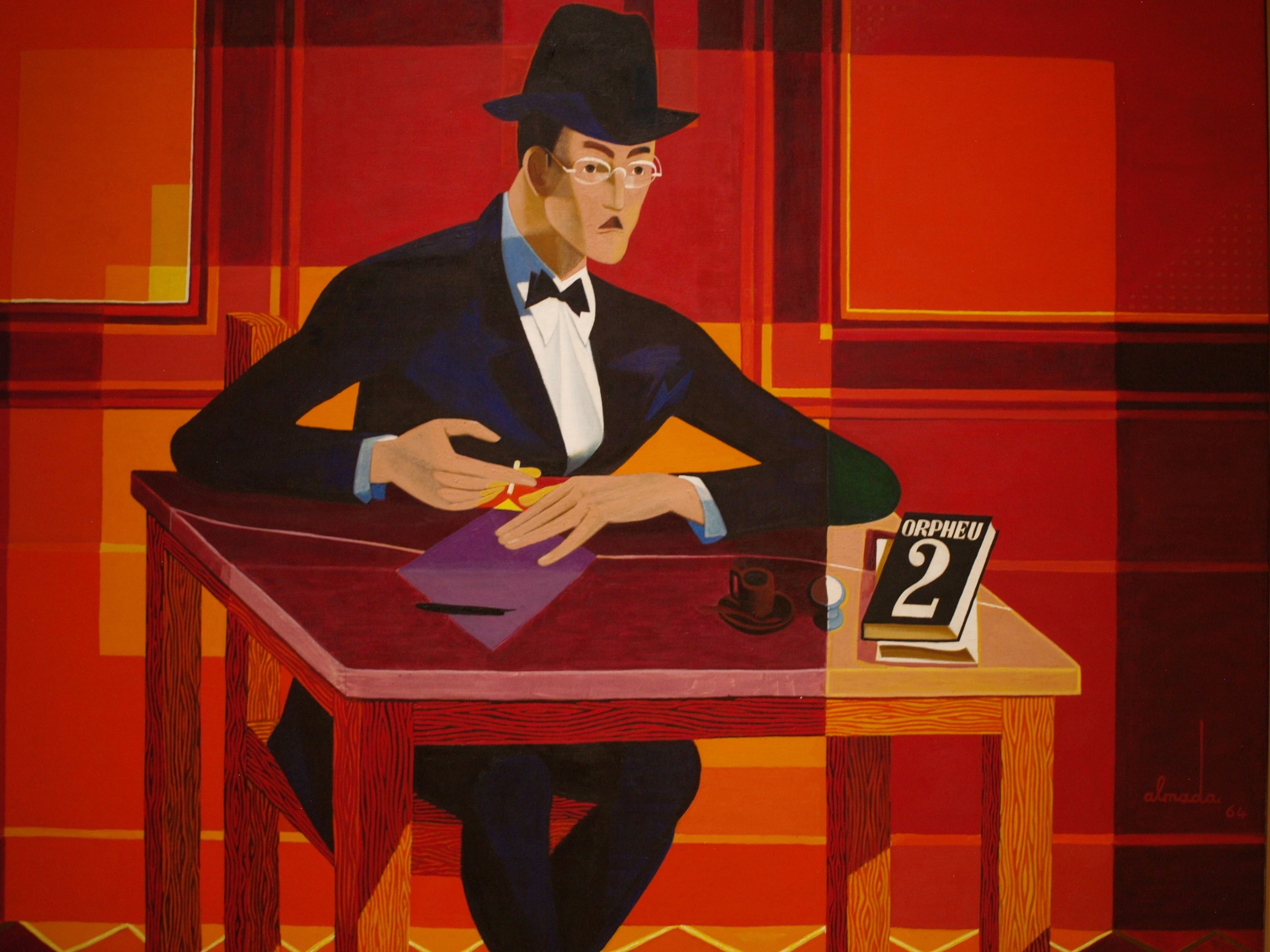
We are late for the guided tour, and by the time we finally enter Casa Pessoa, the group under Mr Bartholomew Ryan, specialist in Fernando Pessoa and holder of a PhD in Philosophy, is already on the second floor and have discussed the poet’s pseudonyms and different personas. Álvaro Campos, the engineer, who represents the ecstasy of experience and writes in free verse; Ricardo Reis, the doctor who writes in meters and stanzas; Alberto Caeiro, the shepherd who is against all sentimentality, and writes in free verse; and, of course, the poems Fernando Pessoa wrote under his name, marked by their innovative language. As we catch up with the group, a woman is asking whether Pessoa was indeed a schizophrenic—a fair question, considering how he got the different figures he had built in his mind to have literary discussions.
“He was worried he might go mad”, says Dr Ryan. “There was some madness and dementia in his family. And he was worried about that. He was on the edge. But he was very much in control of what he was doing”.
The next room houses part of the poet’s incredible book collection. The only real property he ever had. A curious, inquisitive reader who was interested in almost everything, he read all things from Homer to T.S. Eliot; from Omar Khayyam’s Collection of Poetry to books about magic and astrology. And his books are filled with his own notes, as we see in the beautiful display cabinets with the exhibits and the explanatory signs. “Pessoa”, continues Dr Ryan, “was interested in many things. In Islamic Philosophy and Persian ideas, in India and Indian philosophy and Indian thought. He also wanted to create a new paganism. He went even further. He talks about a Fifth Empire, which is a fantastic absurdist element. He said, there’s been four Empires, the Greek, the Roman, the Christian and the British. But the Fifth Empire will be an empire of Portuguese poets led by… you know who? Fernando Pessoa! Of course he was having fun. We have to remember, Pessoa had a great sense of humour. He didn’t take himself that seriously. And yet he did. He believed in everything and nothing. He was always playing. Even in his most seemingly depressive poem. There’s a humour going on in there. He says, give me more wine, because life is nothing. There’s something enjoyable about it”.
The tour continues around the house where the poet spent the last fifteen years of his life, and which has now been respectfully converted into an interesting museum. His bed is preserved in one of the small room: a narrow, single bed with a trunk at its foot. The famous trunk. Ryan explains that is not the real trunk. Because the real trunk is in a private household. In this trunk where Pessoa dumped all his unfinished and finished poems is the Book of Disquiet, which has no order. It’s chaotic. Every edition of the Book of Disquiet is different. And when he died, he left thousands of pages of writing. And some of it is really hard to decipher. And it’s taken decades to this day. Scholars are still trying.
“Pessoa knew and felt he was a great poet”, continues Ryan, who is a true Pessoano (as the Portuguese call the poet’s passionate scholars) and is the best possible guide you could have. “He just had terrible trouble getting things done. He loved lists. He even has a heteronym called the Baron of Tales. One of the last heteronyms who writes a small book called The Education of a stoic, and it’s about the impossibility of finishing perfect works of art. And he can’t finish it, so he kills himself. So there’s humour there”.
Shortly before the end of the tour, Ryan tells us about Ophelia. The only official love affair Pessoa ever had. Ophelia was a smart, very attractive woman. They met in the office where Pessoa was working. She was hired by the same office in downtown Lisbon. And there was an automatic connection between them. They start talking, and flirting probably and one night in the office, he was working late. She was still there, and the electricity went off, and he went over to her and quoted something from Hamlet and gave her a kiss! From that night they started having these little walks and kisses, and they exchanged lots of letters. But he never introduced her to his family. Actually, he broke off the engagement as soon as his mother moved back from South Africa.
Then nine years later, in 1929, Ophelia’s nephew who was also a poet and admired Pessoa meets him and Pessoa gives him a photograph where you can see him drinking by a bar. The nephew sent this photograph to Ophelia. And she wrote Pessoa a note and they resumed their affair in the same way—a few walks from time to time, letters between the two of them. Then he broke her heart again, and after six years he died. And she was devastated. She went on to marry, never had any children herself and near the end of her life, after her husband had died, she said she only had one true love in her life.
A.R.