

Where art’s heart beat

Our appointment is for 11.00, and Google Maps says that if I start now, at 10.15, at 10.35 I’ll reach AR.CO — the independent art school which, as I have heard, stands out for its liberal and highly experimental method of teaching.
I set off, and along the way my internet connection disappears. Horrified, I realise I have not noted down the address; I am almost out of town, and even if I had the address there is no one around to direct me. In my earphones the voice of Madelen Peyroux is singing Smile, which now pours into my brain like a sedative. Since I am quite close and I do not know which way to take, I stop briefly to admire the miracle called 25 de Abril, the bridge named after the Carnation Revolution of 1974. Suddenly I see an Asian woman walking down the other side of the road, I stop her and she helps me find the address on her phone. Armed with her sketchy directions, I walk on in a state of stress. It will take the additional help of a gentleman from a bathroom equipment store in the middle of nowhere, the kindness of a strongly-built woman who put down her two heavy shopping bags to tell me I was off course and turn me in the right direction, and finally the knowledge of an aged street-sweeper lady who spoke not a word of English but obviously knew every street in the area and was kind and patient enough to repeat her directions several times and with lots of gestures.
Ana Martinho, member of the board of Directors, is a pleasant surprise. She has been waiting for me for an hour but does not seem annoyed. “So you came here in the old way, asking for directions. It must have been interesting”, she says when I tell her my adventure. We share a gaze and a smile of mutual understanding. As we start out tour of the school, I am thinking that her position in the Board of Directors is no accident.
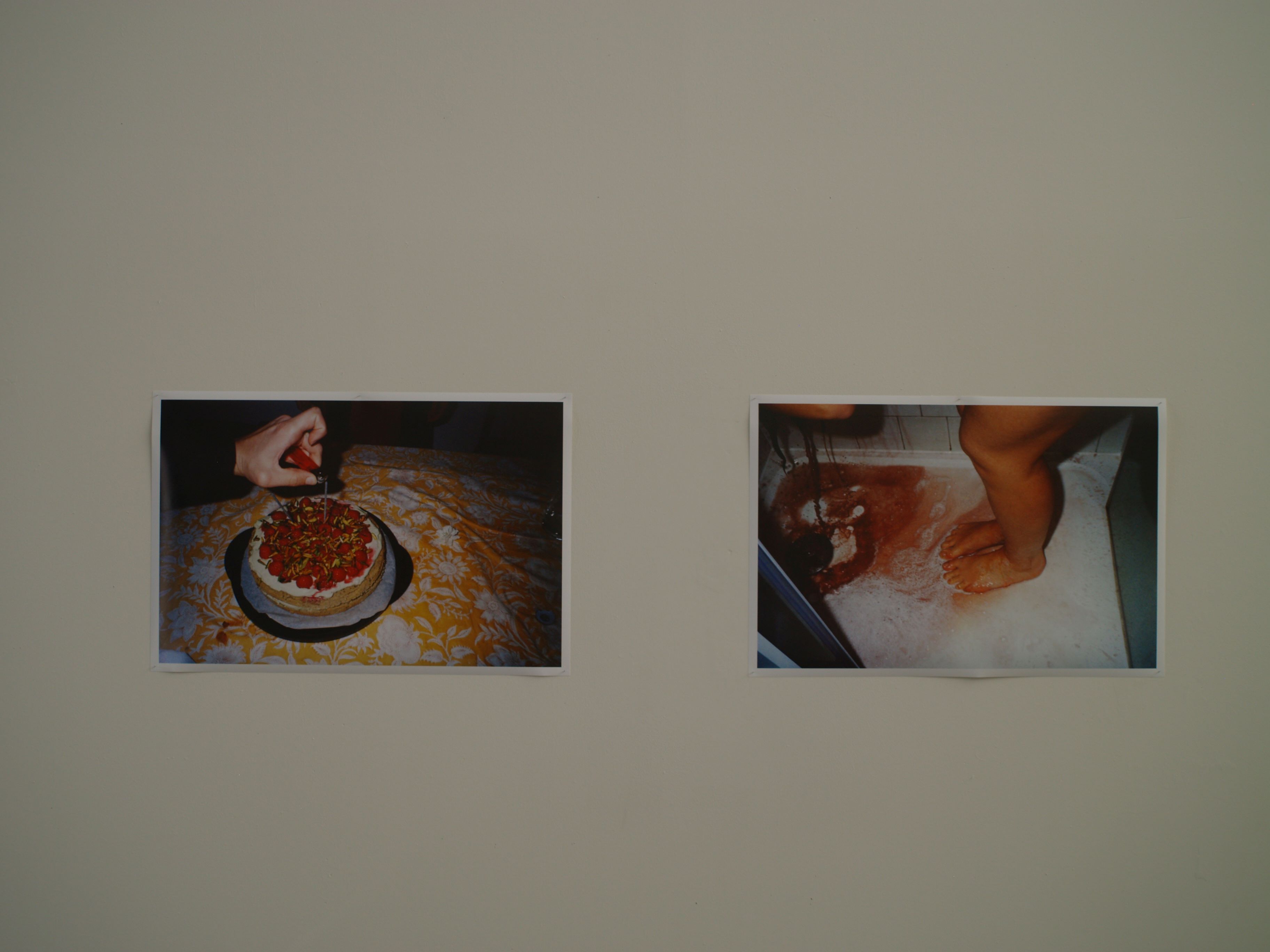
The large, oblong hall we enter is empty of people, but the walls are full of exquisite photographs. “Here we exhibit the finalists every year”, Ana explains. “Now we have a photography exhibition, but we do many different exhibitions. This space has also received many exhibitions from outside the school, from fine artists. It’s a very site-specific place”. In the next room we interrupt a painting class. The northern light comes from the high windows onto the drawings of the students, who join their teacher in a polite greeting and immediately forget about us, going back to their work as if we weren’t there. Ana tells me that the school has departments of drawing, painting illustration and comics, jewellery, ceramics, photography, cinema, etc. “We also had glass. But it changes as the demand progresses. What really characterises us is this independence. We are not dependent on any official program. We depend exclusively on our own funding from tuition fees. We have some support for investments and for scholarships. But we are truly an independent, experimental school. In Arco we don’t have grades or exams, you don’t miss, you don’t have faults, but you do have progression and responsibility. And the progression of each student is evaluated on the basis of their portfolio.
We are also very flexible in the different departments that we offer. If, let’s say, somebody already in the fourth or fifth year needs to try something in another department to improve his work, then we allow him to go. We adapt the program if we need to. But we are also formal in the way that the school is organised in progression for three full years, for the technical development of the work and then advanced course where you do your own personal work”.
In the next room, vertical partitions divide the long benches into small boxes, with students hunched over and working silently each in their own box. The jewellery department. Ana explains that here they learn the traditional techniques of working with all kinds of metal, stones and the history of jewellery. “The idea”, she says, “is to help them develop their own personal work. The first year they have proper classes, formal classes, then second, third year, they start progressing into their own style. And they have their own workspace like an atelier, like they were already autonomous to develop their own work”.
I ask her which is the most popular department with students. “Ceramics! Imagine, twenty years ago it was photography. But now demand for professionals in the area of photography and artistic photography has decreased due to the social media. Happily, there is renewed interest in analogue photography. Jewellery is doing well. But ceramics are huge. Right now all over Europe, ceramics are very trendy. We have another facility in Almada where the ceramics department is. Because all fine artists are doing ceramics, we had to enlarge the department. It was already on the other side of the river. It’s a 19th century farm. It’s a very beautiful place. But we had a small department that grew, and now it occupies almost the whole farm. And the library is on the other side and also the advanced course where students have their own studio space. This is very important, to be able to develop proper personal work with tutoring’.
They say that when you come into AR.CO, you never leave. I believe it. If I had studied in a place like this, I would always want to return—for the facilities, but also for its people. Ana offers to call for a taxi for me, to avoid a recurrence of my morning adventure. But after my visit to this school I feel brave and full of inspiration. I decline the offer and set off on foot. Who knows where I’ll find myself this time…
L.S.