

War and Peace in one shot

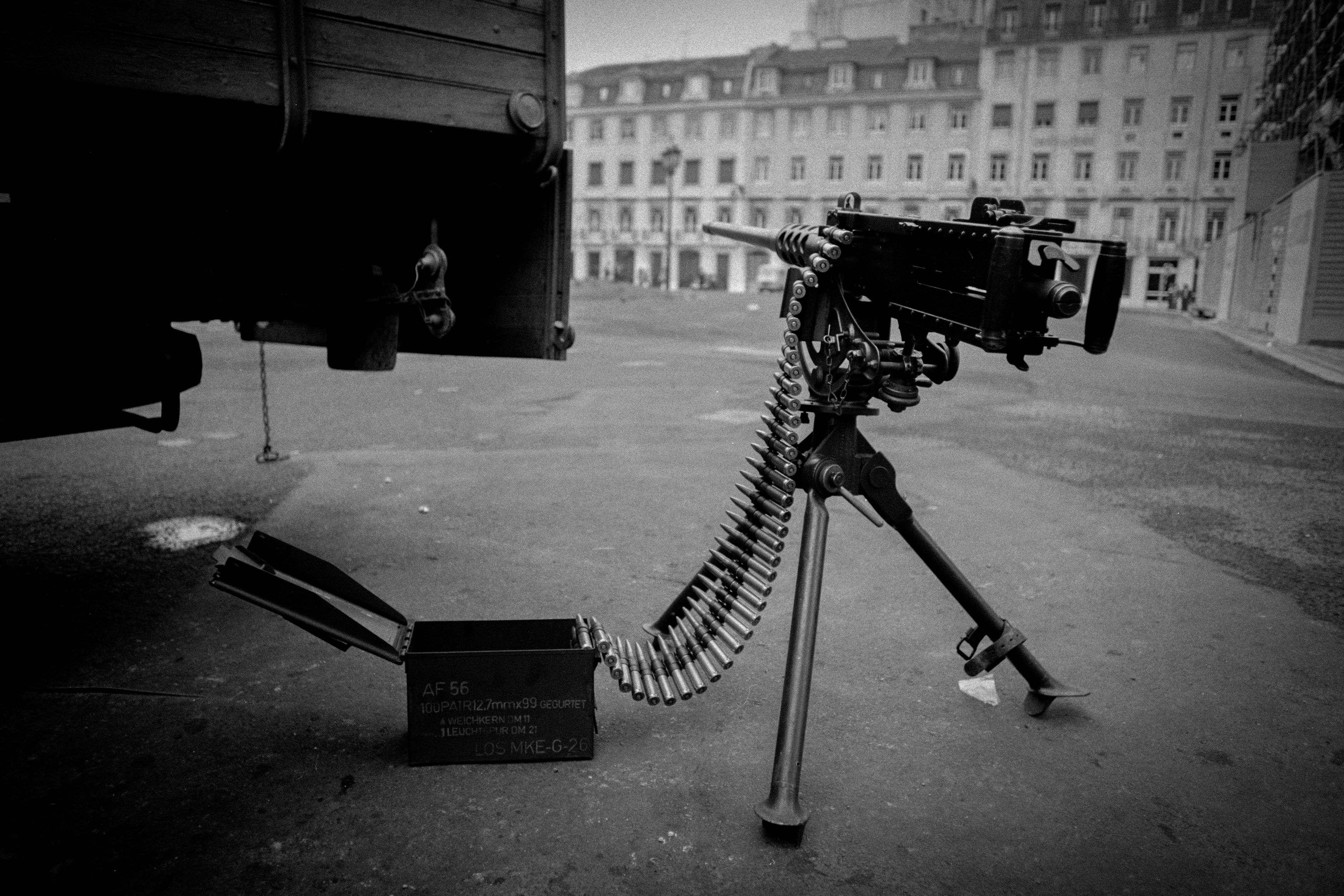 Alfredo Cunha
By Lina Stefanou
We met shortly before the presentation of his book Cartografia do Desejo. We only had ten minutes to talk and take a picture. But what he told me in that time was more interesting than I have heard in other, much longer interviews.
The best story from him was when he was in Romania to cover the fall of Ceausescu. He was seriously injured and had to spend one year in hospital back in Portugal. While there, Alfredo Cunha fell in love with Fernanda, the doctor who attended him, and when he recovered he asked her to marry him. They have been together to this day, and she is the woman of his life.
In April 1974, when the Carnation Revolution took place, Alfredo was 21 and he spent three days without going home: he was out in the streets all the time, taking photographs. Not surprisingly, he is known as the man who photographed the revolution. His photos are historical documents, because over the years he continued to be always where in theory he could not possibly be. In the most extreme and dangerous situations. Shooting them with his camera. Cunha is not just another photographer. He is the photographer whose images summarise Portugal’s history of the last century—not just events but people as well: his lens has captured some of the country’s greatest poets, writers and artists. Which is why his work has been awarded, turned into books and presented in over 700 exhibitions.
He was born in 1953. His father and grandfather were also photographers, so his path was almost inescapable. He began his professional career in 1970, in advertising and commercial photography; the following year, he made his debut as a photojournalist for the newspaper Notícias da Amadora. His career includes photo series dedicated to the 25th of April 1974, the Portuguese decolonisation in Angola, Mozambique, Guinea-Bissau, São Tomé and Príncipe, East Timor and Cape Verde, the fall of Nicolae Ceausescu in Romania (1989) and the Iraq War (2003). He was the official photographer for two presidents of the Republic, Ramalho Eanes and Mário Soares, who became his friend. He has received the Commendation of the Order of Infante D. Henrique.
Every one of his pictures looks like a fascinating short story. Perhaps because his lens manages to capture the others’ strong emotion, the others’ truth that stands naked and bold before us and stares at us as we contemplate his photos.
We met him at the presentation of his book Cartografia do Desejo, which was accompanied by a small exhibition of his photographs at Ochre Space. And we had a brief chat before the beginning of the event.
The previous century the world was in turbulence and that was an inspiration for you.
I was a very young man and everything for me was a picture.
The word today is different. What is the inspiration for you now?
Life. Love. Hmm… This book, my last book, Cartography of Desire, is about this.
So after all those years, the travels, the wars, the revolutions, you have concluded that love is the most important thing?
Yes! Love and friendship.
Love for somebody or for everything?
Love for everything. For life, For people. For family. For my family.
Do you use Photoshop in your pictures?
No. Maybe small corrections sometimes, maybe the light a little…
You use film, right?
Yes.
What is your favourite camera to shoot with?
My favourite camera is Sony and Leica. Today I work with my new camera, a Hasselblad. I’m still learning my new camera (laughs).
Would you say you’re still learning in your work? After all those years?
Yes, of course.
Where do you find your models?I do not seek them, they seek me because they need the pictures. They are women from concerts, from theatre, from ballet. This one is about feelings and lust, I say as I point in one of the photos in his book.
I like that (smiles). It’s a mirror, a broken mirror.
What do you try to capture when you look through the camera? What are you searching?
Perfection. Beauty. Emotion.
Here… Brutal art in Haiti. Port-au-Prince. I was there, he says and points at another photo in the book—a beautiful portrait of his wife made by Vhils, the well-known Portuguese street artist. The form. The relationship inside a group… The brutal art. The delicacy of the tattoo. The blades…
Why blades?
Because I was afraid of them.
Did you always photograph what frightened you?
Yes. I was also a war reporter. I was in Iraq, and during the revolution I was working for a big newspaper and I covered some wars for the newspaper. So I photographed the war. The dead. In Iraq there was a man who told me to stay safe in a shelter. I did what he said but when I came out of it, I saw this person shot to death on the street. I still have the picture of this man alive, when he was warning me. But I never showed this portrait in exhibitions. Out of respect.
You felt many times lucky in your life? To be alive, I mean?
Yes!
Can I take a picture of you?
Yes. With my camera. My camera protects me. Always…