

Lina’s Diary

Photography & Words: Lina Stefanou
Love at first sight
“How do I get from the airport to the hotel?” I ask sweet Inés of the Atelier Inés Arts & Suites.
“Just take a taxi. It’s the best way”, she replies and supplies an early indication that Naples differs from other European cities, where if you want to take a taxi you must sell your kidney.
After a 20-minute ride, the taxi sets me down in a bustling, colourful neighbourhood with narrow lanes where mopeds spring out from everywhere and threaten to run you over if you are careless. In front of the iron gates, Ravi, a very polite Sri Lankan, is there to help me. We cross the Atelier’s quiet garden with the pomegranate by the entrance, the cacti, the creeping plants and all the other lush vegetation muffling the noise of the street. A smiling Inés awaits us on the stairs to a wonderful house. We’ve had to exchange so many emails and messages that I feel I know her already. She shows me around the beautiful Atelier with its high-ceilinged rooms and the art on the walls, which for the next few days will be my headquarters, my sanctuary and my breath of rest. I leave my things and go out in the streets.
As I walk past the heavy iron door I am assaulted by voices, smells and colours. A heady reality which is –and is not– of this century. A cultural shock. Enticing aromas coming out of small bakeries, greengrocers peddling juicy fruits and vegetables, butchers cutting meat with deft, silent movements, barbershops from another decade receiving their early-morning clients. Housewives with baskets, bags or prams are out for their day’s shopping. Kids roam around as free as if they were in their backyards. Young men smoke and chat in loud voices. I stroll aimlessly, looking around and taking photos. Via Dei Cristallini is full of portraits of famous figures suspended above our heads all along the narrow street. I can see Sophia Loren, Maradona, Luciano Pavarotti and dozens more Italian actors and singers. Later, when I ask Inés what they are there for, she says, “because they are our pride”.
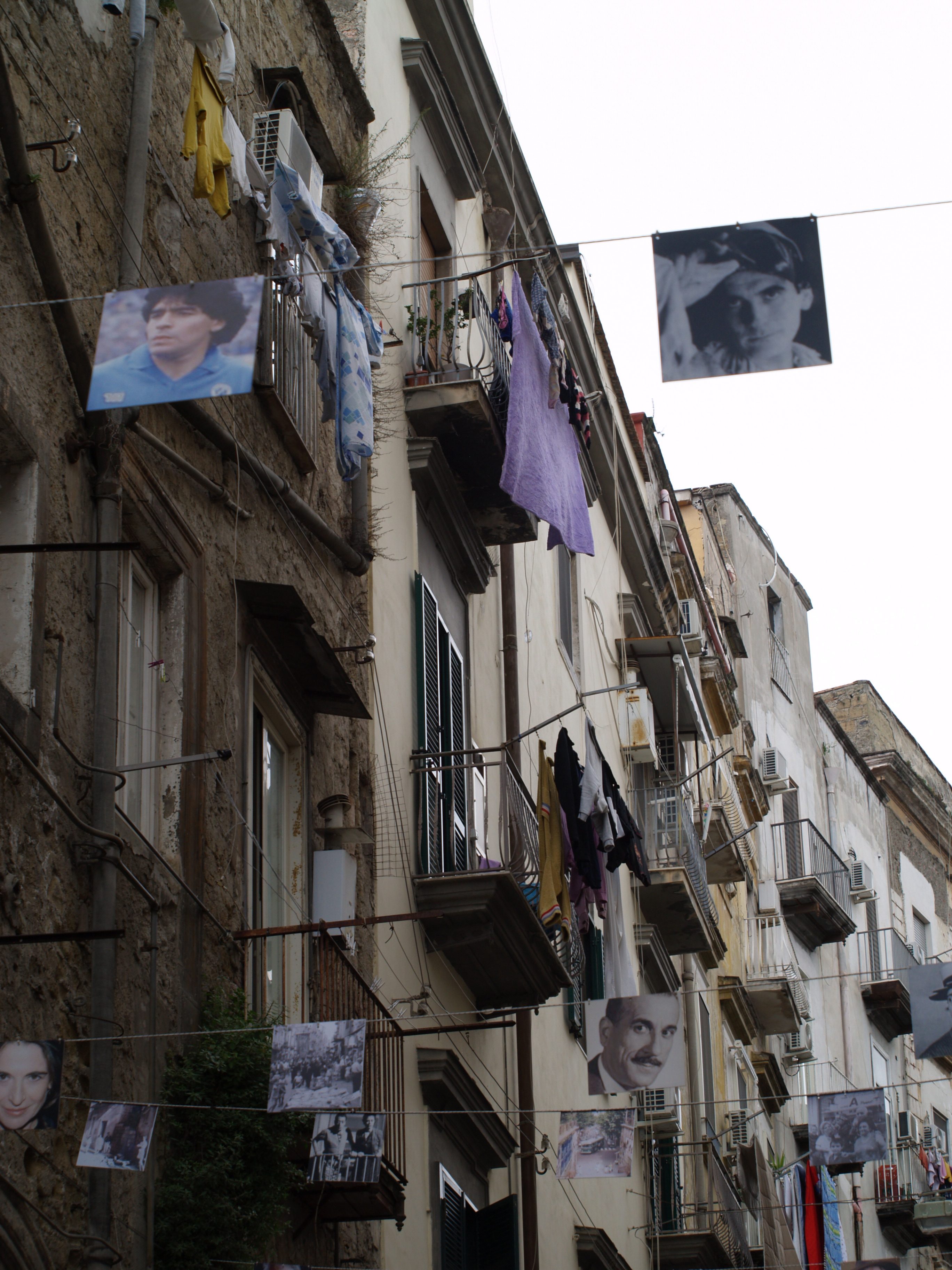
Different kinds of music spill out of the open windows. The curtains are drawn back to let the light in, and I see a series of stills: a plain but sparkling kitchen, a walking stick left on the sill to await its owner, an aged lady in her nightdress sat at her table and leaning to listen to the radio. I am thinking that Naples is all about indiscreet gazes, accumulated poverty, the gaze of religion – and a study in kitsch. In Naples, religion is the authentic kitsch. It is everywhere… in the streets, the plastic flowers, the votive offerings, the tiny altars to the Virgin Mary and other Saints set in niches into the crumbling walls, flanked by drying laundry and plastic sheets of tarp that used to protect something but are now in tatters, forgotten and swaying in the wind on closed balconies. Maradona is also everywhere – another religion. Aged Neapolitans sit around the squares playing scopa (Italian card game) on the little folding tables they bring from home for that purpose.
I am in Sanitá. The old city centre began its course in history as burial grounds for ancient Greeks and Romans, then became a wealthy neighbourhood, an area of hospitals –hence the name, Sanitá– and eventually fell on bad times and was taken over by poverty, crime, drugs and the mafia. It had to be reborn from its ashes, and this took various brave dreamers to make it happen: a priest, a chef, several artists, a few craftspeople and the residents who never abandoned it. Today, Sanitá is among the most interesting, safe and vibrant parts of the city. I already feel in love!
I have dinner at Concettina Ai Tre Santi, which everyone says is an excellent pizzeria. And so it is. The pizza here is on another level. I start with two little pieces of fried dough with beef and ricotta, which I savour slowly to make it last. I opt for a dish with three different kinds of pizza. It’s as if the chef has rejected everything he knew about pizza and used any ingredient that comes to mind. Like the game of an eternal teenager, but the outcome is exquisite! This is truly the tastiest and most different pizza I’ve ever had.
Άλαδε, Μύσται! (To the Sea!)
I walk around aimlessly in order to get the feeling of this boisterous city which was inhabited since the 9th century BC, initially known as Parthenope (from the mermaid of Greek mythology) and renamed into Neapolis, New City, in the 6th c. BC to become the centre of Magna Grecia. Then came the Romans, the Byzantines, the Lombards, the Angevins, the Spaniards, and so on.
Can you ‘peel’ a city? Naples you can, certainly. It comes in layers that follow its rich history; a city with centuries’ worth of legacy, and one of the major ports of Europe. I walk on, with Lampedusa’s Gattopardo turning in my mind. That’s because past and present live in a tight embrace in this city with its dirty streets and palaces.
“Seawards, Initiates”, as they once said in ancient Eleusis. I walk down via Duomo in search of the sea. I reach via Nuova Marina but I can see no marina, and no sea. I smell the sea, I inhale it but I don’t see it. The quay is all built up with storehouses and blocked by containers. On this side of the city, the sea is inaccessible. Some ship masts are barely visible, and instead of seagulls I see concrete and cranes with merchandise in their teeth. Homeless people everywhere. I am in one of Europe’s largest ports. The sea here is a commodity, to be traded against strong currency. I walk past the shipyard, Cantieri del Mediterraneo, but again the view is blocked. As I continue, I find the streets strewn with jackets, shoes, a sock… It’s as if it is a front room where the inhabitants have hastily removed clothing and shoes before going out of sight in the back streets – their ‘rooms’. Or it’s like there was a fight, and what I am seeing now is the cinematic remnants of some imaginary brawl, that no city employee cared enough to remove.
At the piazza Masaniello I stop because I see a fluffy white seagull sitting still in a flower bed and standing out among the grey pigeons that walk back and forth around him and feigning indifference. The scene is strange, and when I get nearer I can see why. The seagull is picking at a dead pigeon with its beak and devouring it, as the other pigeons flutter around him, agitated and helpless. They neither look at the seagull nor touch it, but move around it in slow motion, amidst a charged atmosphere. In one second, the romantic image left in me by Jonathan Livingston Seagull gives way to the true picture of this scavenger. I move away disgusted, and not without feeling there is some deep allegory between what I had just seen and this city with its harsh contrasts.
Museo Civico Gaetano Filangieri
I have been told about a museum with rare porcelain exhibits that I should not miss, if only because it had to be moved back from its original location when the street was widened! How do you take a 15th-century building some twenty metres back?
“The museum is a project that began with the restoration of Via Duomo”, explains Chiara, my tour guide. “It had to be widened to make one of the main arteries of the city, and so when it came to this palace, Palazzo Como, they decided that instead of demolishing it –a palace from the 1450s, built by a Venetian family– they would dismantle the facade, move it 20 meters back, and then build it back up again”. I am thinking how many buildings could have been saved in Athens with this method, but this is not the time for such thoughts. Gaetano Filangieri Principe di Satriano, an art historian and collector and the founder of this Museum, had no heirs and decided to leave this as his legacy to the city and keep his name alive. And he succeeded; his name lives on. The grandiose interior is lined with walnut panelling and the walls are filled with paintings from his collection. I go rather quickly through the collection of Italian and Spanish weapons and stop to admire the Head of John the Baptist, free of blood and quietly resting in its plate as if asleep, by Jusepe de Ribera. Next to it, Battistello’s San Giovannino shows St John as a child with a playful yet wise gaze, looking at you as if he knows something we still ignore. On the way up the wooden staircase, a painting with the map of Neapolitan provinces attracts my curiosity. I hasten past a showcase with a horrible chastity belt – a metal instrument of torture, because men may have been able to conquer the world but seemed unable to conquer the hearts of their women.
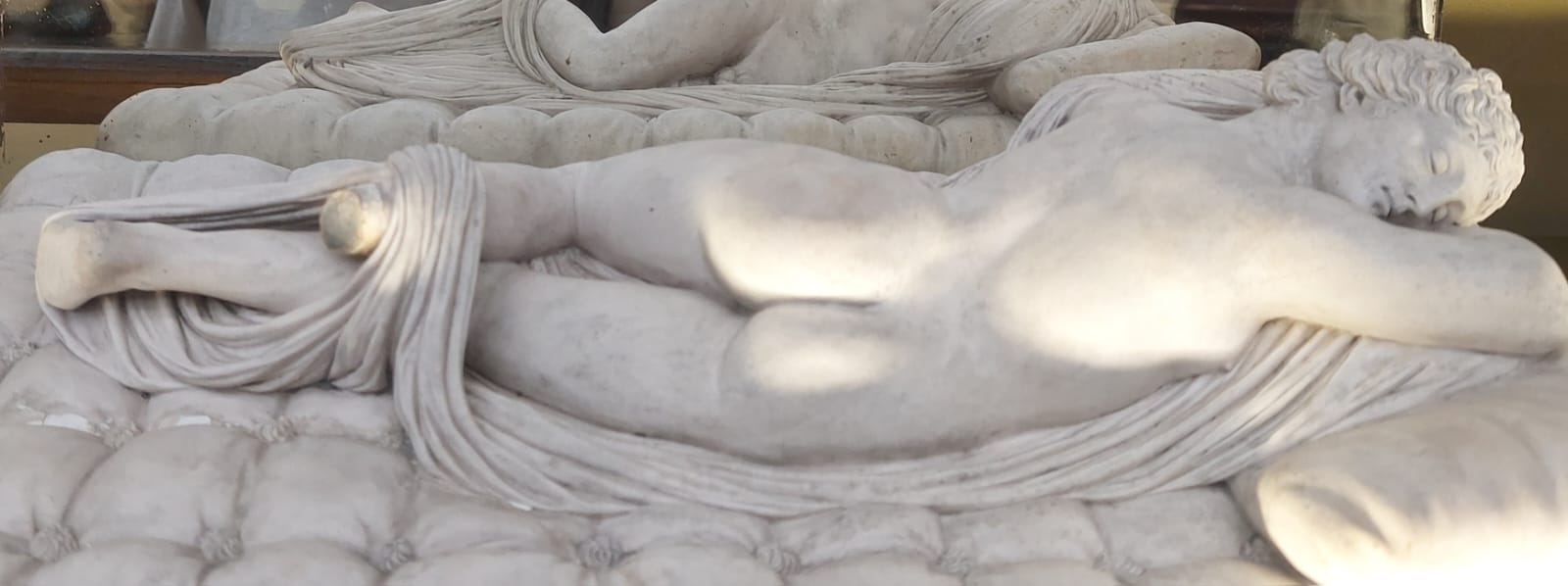
On the upper floor I am finally before the collection of French and German porcelain, the main reason for my visit. Small, elaborate masterpieces of almost translucent china, with hand-painted images of a time and a nature that are no more. Gold-painted hot chocolate cups, miniature statuettes with scenes reminiscent of the books of Hector Malot – in a happier version. Iron armours and plates, jugs and drinking cups from a romantic age full of beauty and cruelty. If you visit the museum, you must ask to be shown the showcase with Chinese and Japanese porcelain items, which are kept separately.
On my way out I stop before Luca Giordano‘s The Triumph of Galatea. Painted in a darker, heavier mood than Raphael’s lightweight exaltation of the nymph of some century-and-a-half earlier, the painting brings to my mind the verses of my friend the poet Yorgos Kakoulidis:
And I await to see a prayer not smelling
of blood
A bride not adorned for her grave.
What’s the secret of Italians for staying so thin while eating sweets, pasta and fried dishes all the time? We talked about it with Tom (Hall), but found no answer. At Lombardi’s, the old trattoria that goes back to the late 19th century, I am sitting next to noisy Italian families and two silent guys with identical thick rings on their fingers; the could well be mafia members – Don So-and-so and his son. As my imagination runs wild and I think of cars screeching to a halt in the street, thugs machine-gunning the windows and myself dying by mistake under a torrent of broken glass, a dish of fried fish lands on the table before me. (I thought I had ordered artichokes, but I was distracted and mixed up ‘anchovies’ and ‘artichokes’… still, it could have been worse). The aged waiter suggests I accompany the fish with bread. I try it hesitantly, and he’s absolutely right. It’s all so delicious that I soon forget my cinematic death. Now, my only concern is about gaining weight. I share this anxiety, through a couple of Italian words and lots of gestures, with the waiter as he returns with a dish of pasta alle vongole. He looks at me, smiles and says: Eh, mangia oggi e domani mangia solo insalata! [Well, eat today and have just a salad tomorrow!). So this is how they do it, Tom.
I go for a stroll to aid digestion. Now I know why Camilleri’s Salvo Montalbano always felt the need for a walk after a meal at Enzo’s.
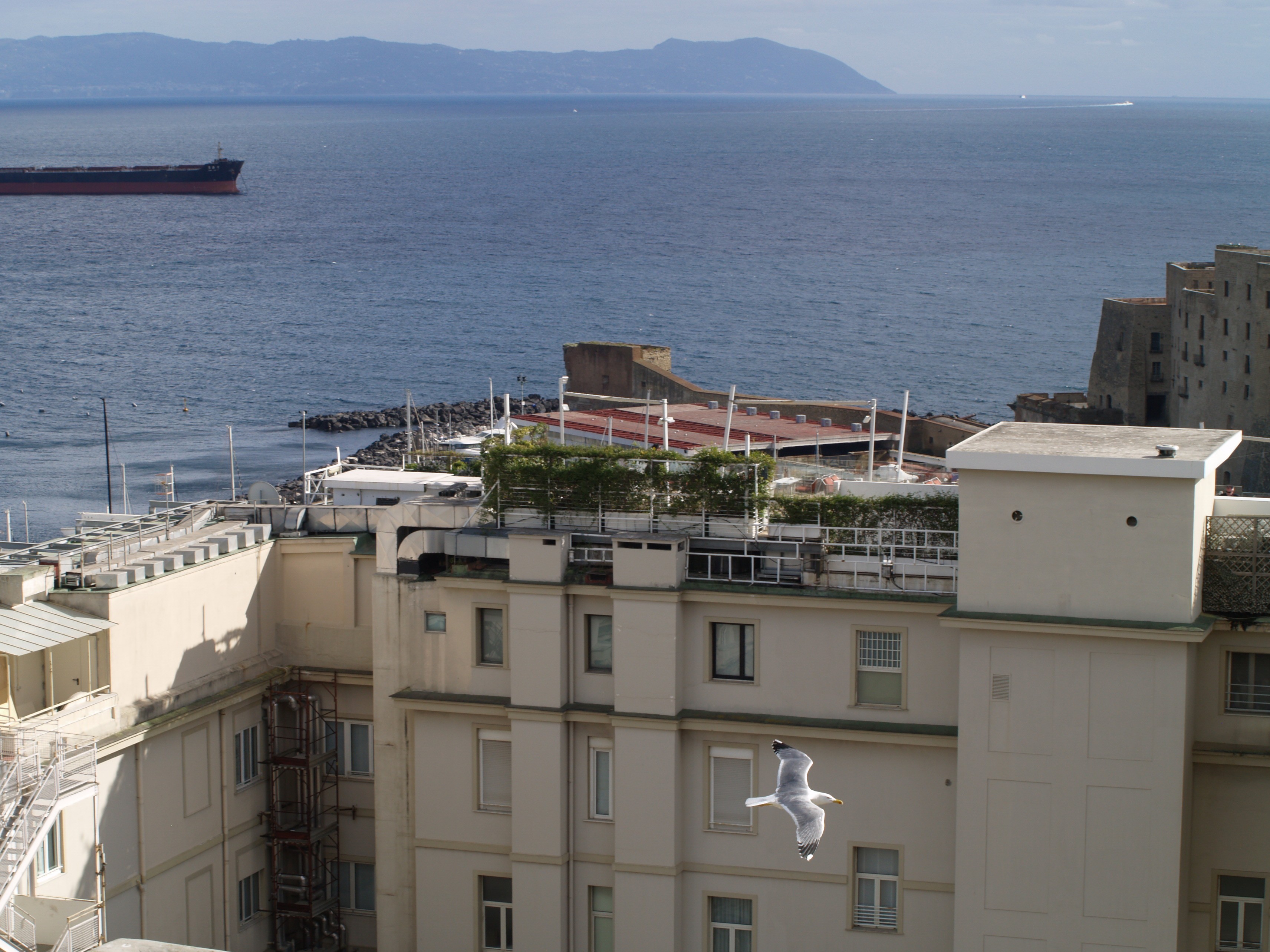
I end up at the Museo Madre, which brings together the artists of Arte Povera and more recent ones: Francesco Clemente, Jeff Coons, Christian Leperino, Jannis Kounellis, Richard Serra, Sol LeWitt, Luisa Lambri, and Piero Manzoni’s Merda d’artista. I spend almost half an hour mesmerised by Rebecca Horn’s Spirits, with its mirrors concealing behind them the human skulls that represent the fate of us all. At a glance, Rebecca shows you both the present and the future resting upon the plain truth that all of us become past at some point. I go out to the Museum’s rooftop with its panoramic views of the city, and at long last I see the sea. It seems that you have to rise (literally and metaphorically) in order to see the sea in Naples. This may have been what Giovanna Bianco and Pino Valente were thinking in 2015, when they built their work with the iron words that dominates the roof:
Il mare non bagna Napoli (The sea does not bathe Naples). The fact that the words are made of iron is probably no accident.
I am walking down Spaccanapoli, one of the earliest streets of Naples. Seen from above, it looks like an incision that splits the city in two. There comes a moment, when you are in a foreign place, when you know you are about to commit a sin. You cross yourself and walk into the first shop that looks promising and whose aromas have dragged you in by the nose. You order an espresso and a sfogliatella, to feel the crispy layers of caramelised dough cracking in your mouth and mingling with the soft white cream filling; it seems to come as solace for what has occurred and what is to follow. After that, refreshed and smiling shyly with the joy of this momentary weakness, you walk out and continue on your way without remorse. Tomorrow, I’ll just have a salad.
Jam session and craftsmanship
I had heard that Naples used to have a great jazz scene, but my search for anything worth going to had turned up nothing. I decide to go to Ba Bar House because it has a nice bar, a fireplace and a table football, and I know I would be fine going there on my own. After getting lost –as there are another two Ba Bars– I finally find what I am after, push the door and -surpise, surprise- there is a live jam session on! I learn that this takes place every Monday here. Students from the Conservatoire as well as professional musicians come here late in the evening and improvise. I nurse my drink as I watch the terrific drummer Elisabetta Saviano forcing a handsome, tall sax player bow to her after a ‘battle’ which he barely survives. I am thinking that this is a girl we are bound to hear about at some point.
The next day I go up to the Real Fabbrica di Capodimonte, which lies within the magical forest of Capodimonte. The old china factory of 1743 is now a school where over 500 young people come to learn the art of making objects out of porcelain and clay. Professor Luca becomes my tour guide. I look at the students’ creations, the disused kilns, porcelain in its original form (just a grey powder), porcelain as a liquid and porcelain as plasticine. I learn about the various degrees of firing (I don’t know why, but I have retained the information that the fourth firing is used when you want to το apply gold or platimum; it may be because any mention of gold unconsciously draws our attention). I see the works of well-known artists who were invited by the School, such as Santiago Calatrava and Patricia Urquiola. I am told about the collaboration with Edit Napoli, the collaboration to ensure the survival of yet another traditional craft that requires devotion and passion. Judging by the ones I met, the teachers in this school and the director, Valter Luca De Bartolomeis, certainly have it. This is not about teaching how to build china objects, but also about painting each object so that it tells a story.
After the visit I wander around this exquisite park with the venerable trees and the broad avenues. I have been told that I can see here the historic oven where the first Margherita pizza in history was baked in 1889, but I am too tired to search and the park is huge. I reach the Museum, which is closed for renovation. This means I miss my chance to see one of Caravaggio’s best paintings – but I am compensated by the great views from up here: Naples unfolds before me with its narrow lanes, its palazzi and its churches. The sea is far in the back, Mount Vesuvius is resting on the left.
On the way back I realise I am hungry. I go into a traditional trattoria, and soon a dish of cannelloni filled with ricotta, eggplants and red sauce lands before me (I got my order right this time). As I eat, I am thinking that cannelloni look like Naples. They are split in two, lust as Spaccanapoli runs through the historical centre. The thick ricotta, the tomato and the pieces of eggplant come in layers, like this city’s past that emerges wherever you dig, wherever you stop. The texture reminds you that life is at once solid and fragile. Like the soil of a city built next to an active volcano.
Tomorrow I’ll go down to the rich Posillipo area, to see the sea from up close and check out where Neapolitans go for a swim.